

BAAB-accredited programmes are delivered at degree level or degree- equivalent Level 6 in England, Wales and Northern Ireland and Level 10 in Scotland.
Across healthcare education, Level 6 is recognised as the threshold where practitioners are prepared for autonomous practice. It ensures that graduates are not simply trained in techniques, but educated to understand underlying principles, assess patients safely, and adapt treatment responsibly in real clinical settings.
This depth of training is essential for protecting the public and ensuring professional accountability because it represents the point at which students are expected to move into professional-level thinking: critical analysis, clinical reasoning, reflective practice, and the ability to make safe, informed decisions in complex patient care situations.
Our focus - student-centred, practice-led, patient-centred
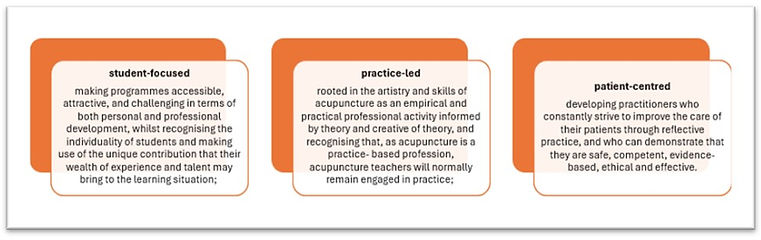
Putting students, clinical practice and patients at the centre of acupuncture education, we expect all accredited programmes to demonstrate the highest standards of equity, effectiveness, accountability and academic rigour.
Programme standards
Equitable
Programmes must ensure equality of opportunity in all admissions, teaching and assessment practices, creating inclusive learning environments where all students can succeed on the basis of merit and capability.
Effective
Programmes must deliver high-quality education that makes appropriate use of resources while maintaining the conditions required for effective learning. This includes ensuring sufficient student numbers to support peer learning and a collegiate environment, and maintaining appropriate teacher-to-student ratios in practical and clinical teaching.
Accountable
Programmes must be transparent, open to scrutiny, and able to demonstrate and justify decisions in clear professional and academic terms.
Critically self-aware and academically rigorous
Programmes must operate at a standard consistent with higher education degree-level study. They must be grounded in critical enquiry, reflective practice and academic rigour, and demonstrate awareness of developments within acupuncture, related healthcare disciplines, and the broader social and healthcare context in which practice takes place.
Graduate outcomes
Accredited programmes must produce graduates who are:
Clinically responsible and self-aware
Able to recognise the limits of their competence and make appropriate referrals to other healthcare professionals where necessary.
Competent and committed to lifelong learning
Equipped with the knowledge, skills, professional attitudes and commitment required for ongoing professional development, enabling safe, confident and respectful practice in independent, collaborative and/or inter-professional settings.
Responsive to evolving healthcare needs
Able to adapt to changing patient needs, emerging evidence, and evolving professional expectations, and to integrate research evidence into clinical decision-making and reflective practice.
Collaborative in practice
Able to engage constructively with other healthcare professionals, recognising shared responsibilities in patient care and contributing to integrated and patient-centred approaches within the wider healthcare system.